Pizza Time
Unfinished; posting anyway.
Pizza and 2+1 offers go together like Apache Airflow and data engineering: Nobody knows why, but it is a thing.
The premise is deceptively simple: Buy three pizzas and get the cheapest one for free. (More like 3-1 if you ask me, but I’m not a marketing guru.)
“Nothing complicated” you might think, and if you are a monster that can eat three pizzas in one sitting (shout out to my past self) or a small family and your pizza consumption patterns end at three pizzas, you are mostly right.
But if you are one of my 2 regular readers (hi mum 👋), at this point you probably suspect we will try to find problems where others seek delicious satisfaction.
Let’s start simple.
Maximizing Savings
Faithful to the tradition of the spherical cow we will ignore delivery/packaging/… costs.
Given a group of people wanting to buy pizzas priced , find a division into groups (of three and at most one group of less than three) to maximize overall savings with 2+1 offer.
One can try brute force, but that is no way to feed a large crowd of hungry people who are not willing to wait until you iterate through all the permutations/combinations/…
from itertools import islice, permutations
from numbers import Number
from random import choices

pizza_prices = choices(range(1,10), k=10)

def savings(groups: list[list[Number]]) -> Number:
    return sum(min(g) for g in groups if len(g) == 3)

max_savings = 0
best_split = None

for l in permutations(pizza_prices):
    it = iter(l)
    groups = tuple(iter(lambda: tuple(islice(it, 3)),()))
    s = savings(groups)
    if s > max_savings:
        max_savings = s
        best_split = groups

print(f"{max_savings = }\n{best_split = }")
What a fun little coincidence that the solution here is a glutenous
gluttonous greedy algorithm.
from decimal import Decimal
from fractions import Fraction
from itertools import batched
from typing import Generic, Iterable, Literal, Protocol, Sized, TypeVar

# Is there a better way to make mypy happy?
T = TypeVar("T", int, float, Decimal, Fraction, covariant=True)


class IterableSized(Generic[T], Iterable[T], Sized, Protocol): ...


def savings(groups: Iterable[IterableSized[T]]) -> T | Literal[0]:
    return sum(min(g) for g in groups if len(g) == 3)


def optimal_grouping(prices: Iterable[T]) -> Iterable[tuple[T, ...]]:
    return batched(sorted(prices, reverse=True), 3)
You may feel tempted to copy-paste this into your “get-me-a-cheap-pizza.py”, but at the end of the day, I’m just a stranger on the Internet, and you might not want to base your financial decisions on a random Python snippet.
To convince yourself that max_savings produces optimal
grouping as valuated by savings, you may employ the following
steps:
- Take a random permutation.
- Split it into groups of three + tail.
- Fill the tail (if there is one) with 0s to form a full group.
- Permutations within groups don’t do anything to savings
(because minimum always takes smallest regardless of its position).
- Reverse-sort elements within groups.
- Permutations of groups don’t do anything to savings
(because of associativity of sum).
- Reverse-sort groups by the smallest (after sorting the last) element.
- Boundaries of groups.
- Pick two neighbouring groups , .
- Such that .
- We know .
- Thus by swapping elements c and d
- savings can either improve
- or stay the same.
- Repeat from reverse-sorting within groups.
- If there are no such groups, the elements are reverse-sorted.
- Pick two neighbouring groups , .
- Thus: savings for any permutation would either stay the same or be improved by reverse-sorting the permutation.
And while some assembly is still required to turn that into a more solid proof, I now imagine you checking up on nearby pizza providers to see which ones offer 2+1.
By the way, this approach can be generalized for any m+n scheme for .
from decimal import Decimal
from fractions import Fraction
from itertools import batched
from typing import Iterable, Literal, TypeVar

T = TypeVar("T", int, float, Decimal, Fraction, covariant=True)


def savings(groups: Iterable[Iterable[T]], m: int, n: int) -> T | Literal[0]:
    assert m > 0
    assert n > 0
    return sum(p for g in groups for p in sorted(g)[:-m][:n])


def optimal_grouping(prices: Iterable[T], m: int, n: int) -> Iterable[tuple[T, ...]]:
    assert m > 0
    assert n > 0
    return batched(sorted(prices, reverse=True), m + n)
A proof can follow similar structure.
Can you generalize for m+n for ? (Buy two and half pizzas and get second half free.)Splitting the Savings
Armed with the way to maximize savings, some entrepreneurially-spirited readers might already be looking for more people to join them on the saving-on-pizza (ad)venture. After all, even if I can/want to buy only one pizza, there is nothing stopping me from finding more people to join-in on the fun.
And here we hit another complication: how to split the savings? Alternatively, how to do proper cost attribution? Imagine two friends buying three pizzas to share (each arbitrarily split). Or three individuals forming an alliance to get the exact pizza they want for the best possible price. Should we be doing attribution per person or per pizza? Or perhaps some other way? We need a way to evaluate them, a criterion that would help us evaluate which split is the best.
That is a lot of questions and we’ll talk about some of them.
Any Split is Okay
First and foremost, any split that all the participants agree on is “okay”. Taking as an example two people and total price of pizza , the split (one friend foots the bill) is okay. Even split for is fine. Though in these cases there is usually some other value flowing that is invisible to our pizza-and-money-focused sight. (Friendship, being a parent, or whatever reason one might have to financially incentivize someone to have food with them.)
We will focus mainly on cases where participating
parties want to consume only specific amount of specific pizza(s)
and we’ll assume non-existence of fridges 🤪. (Person who
wants 2 pizzas but orders 3 just to get the discount gets 0 utility
enjoyment from the last pizza.)
Before proceeding any further let’s introduce couple of handy shorthands.
, the total original price.
, the optimal discount.
, the optimal price .
And I will omit when convenient/obvious.
Price-Proportional Split
This split is based on the assumption that the value of each pizza is proportional to its original (pre-discount) price and we will just uniformly scale the value of each pizza by ratio , so new prices are
With these new prices, people split pizza among themselves and contribute proportionally to what they got of each pizza.
Instead of properties definitions, lemmas and proofs of this split having or not having said properties, and fancy corollaries, here’s a bunch of examples to think about:
- Group bought all same-priced pizzas. After scaling all still cost the same. Makes sense.
- Two friends bought 3 pizzas and each friend had half of each pizza. Each one will pay half of . Makes sense.
- Previous example generalized to 1 friend eating and the other eating . Makes sense.
- Generalization to multiple participants is also sensible.
- If a participant ends up having no pizza, they pay 0. Makes sense.
- People with expensive taste pay more than people on the other side of the spectrum. Makes sense.
- Nobody pays more than they would have on their own. Makes sense.
Overall a very reasonable split, innit? Especially given that it is easy and (computationally) cheap to calculate.
Saving-Contribution-Proportional Split
So why would anyone ever be unhappy with the price-proportional split?
As an example take an individual who is eyeing a ¤6 pizza. usually buys pizza with and , who also get ¤6 pizzas, each paying ¤4. But what happens if develops more expensive taste and decides to go for a pizza worth ¤12. Suddenly, even though total group saving is still ¤6, needs to pay ¤4.5. Savings distribution (1.5,1.5,3) is skewed towards the person with more expensive taste.
We might try to convince ourselves that this is compensated by having bigger proportion of savings if someone decided to go cheaper, but it is not the same: total savings are unchanged, and still gets the same pizza, yet saves less.
We might want to think about how much each individual contributes to savings rather than total price of pizza. Let’s see how total pizza price develops with all possible group formations.

Here we see that all contribute equally to the discount. So equal split of ¤6 savings seems sensible, making contributions (4,4,10).
How does this generalize to multiple participants? And to m+n discount structure?
To avoid getting overwhelmed let’s scale down to a 1+1 offer. We will still be able to observe the thought process without the combinatorial explosion.
Example: want to buy pizzas priced with 1+1 offer. How much does each contribute to total savings of ¤10?
This case is less straightforward than the previous. How much is contributed by whom is determined by order in which they join. Here are all 6 possible permutations (pizza-party formation orders):
A, B(6),  C(4) -- A alone has no discount,
               -- when B joins they have discount 6
               -- and when C joins they have discount 10
               -- so C contributed only 4.
A, C(6),  B(4)
B, A(6),  C(4)
B, C(10), A(0)
C, A(6),  B(4)
C, B(10), A(0)
And now we average individual discount contributions across all the possibilities:
We just calculated everyone’s average marginal contribution across all possible coalitions, and basically re-discovered Shapley value. Lloyd Stowell Shapley was a rock star in certain circles.

By now you see the problem: Doing this by hand for more participants can entertain perhaps during a flight. To block out a screaming child and a flight attendant with a limited selection of overpriced snacks. (Alternatively you can fill squares with numbers.)
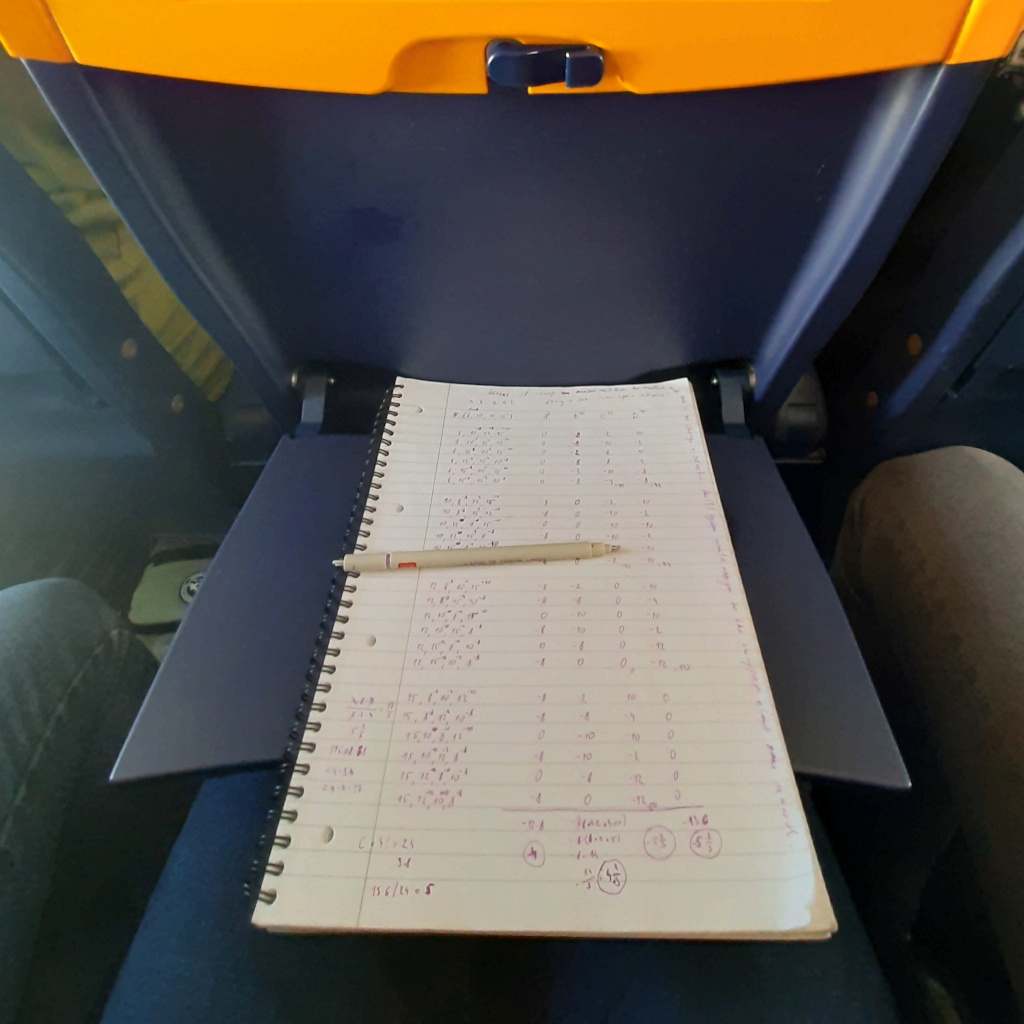
But it is great to notice that going over all the permutations is very repetitive, as contribution of to any permutation of is the same. And things can be reduced even further if we have multiple pizzas with the same price.
At this point you can visualize BFS-style discovery of a lattice-shaped graph that has nodes for all sub-multi-sets, edges represent adding an element, annotated with the element, count (how many ways we can travel it from the root) and marginal contribution of that element for the source node.

I know what you are thinking, but hear me out.

End
That’s all for now 🍕
I’d like to extend this article with:
- Algorithm to calculate Shapley value.
- Complexity
- Good algo collapses to good complexity on degenerated inputs (all same prices, …)
- A paragraph or two on stability of coalitions
- What motivates people to form this coalition and to not kick out a person out of a coalition for a higher profit. (Spoiler: fear of lower profit.)